Showing posts with label Math. Show all posts

Wednesday, February 27, 2019

A First Course in Differential Equations with Modeling Applications 10 edition 2012 Zill

A First Course in Differential Equations with Modeling Applications 10 edition 2012 Zill

If a closed-form expression for the solution is not available, the solution may be numerically approximated using computers. The theory of dynamical systems puts emphasis on qualitative analysis of systems described by differential equations, while many numerical methods have been developed to determine solutions  with a given degree


Image result for differential equations by zill


differential equation is a mathematical equation that relates some function with its derivatives. In applications, the functions usually represent physical quantities, the derivatives represent their rates of change, and the equation defines a relationship between the two. Because such relations are extremely common, differential equations play a prominent role in many disciplines including engineering, physics, economics, and biology.
In pure mathematics, differential equations are studied from several different perspectives, mostly concerned with their solutions—the set of functions that satisfy the equation. Only the simplest differential equations are solvable by explicit formulas; however, some properties of solutions of a given differential equation may be determined without finding their exact form.

Differential equations first came into existence with the invention of calculus by Newton and Leibniz. In Chapter 2 of his 1671 work Methodus fluxionum et Serierum Infinitarum,Isaac Newton listed three kinds of differential equations:
He solves these examples and others using infinite series and discusses the non-uniqueness of solutions.
Jacob Bernoulli proposed the Bernoulli differential equation in 1695. This is an ordinary differential equation of the form

for which the following year Leibniz obtained solutions by simplifying it.
Historically, the problem of a vibrating string such as that of a musical instrument was studied by Jean le Rond d'Alembert, Leonhard Euler, Daniel Bernoulli, and Joseph-Louis Lagrange. In 1746, d’Alembert discovered the one-dimensional wave equation, and within ten years Euler discovered the three-dimensional wave equation.
The Euler–Lagrange equation was developed in the 1750s by Euler and Lagrange in connection with their studies of the tautochrone problem. This is the problem of determining a curve on which a weighted particle will fall to a fixed point in a fixed amount of time, independent of the starting point.
Lagrange solved this problem in 1755 and sent the solution to Euler. Both further developed Lagrange's method and applied it to mechanics, which led to the formulation of Lagrangian mechanics.
In 1822, Fourier published his work on heat flow in Théorie analytique de la chaleur (The Analytic Theory of Heat), in which he based his reasoning on Newton's law of cooling, namely, that the flow of heat between two adjacent molecules is proportional to the extremely small difference of their temperatures. Contained in this book was Fourier's proposal of his heat equation for conductive diffusion of heat. This partial differential equation is now taught to every student of mathematical physics.


Notes of Calculus with Analytic Geometry

Notes of Calculus with Analytic Geometry

Calculus with Analytics Geometry Cover


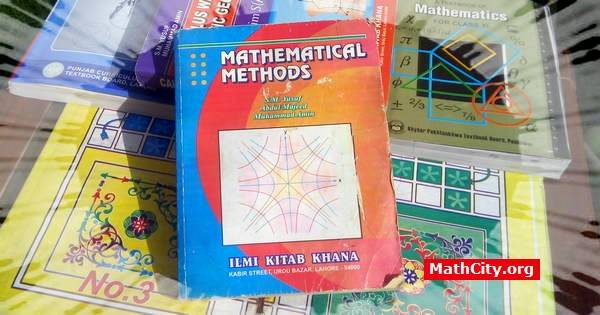
Calculus with Analytic Geometry by Dr. S. M. Yusuf and Prof. Muhammad Amin, published by Ilmi Kitab Khana, Lahore-Pakistan is one of the books studied widely in Bachelor and undergraduate classes. There are total of ten chapters. We try our best to get the notes and solutions of this book written by different authors so that teachers and students can get better understanding of the different notion in mathematics and work hard to learn basic concepts.


List of chapters

Notes of Mathematical Method

Notes of Mathematical Method

BSc Mathematical Method 


Notes of the Mathematical Method written by by S.M. Yusuf, A. Majeed and M. Amin and published by Ilmi Kitab Khana, Lahore.

The notes given here are provided by awesome peoples, who dare to help others. Some of the notes are send by the authors of these notes and other are send by people who didn't write but share these notes as Open Educational Resources (OER).

DOWNLOAD to Click on Chapters:


Tuesday, February 26, 2019

Calculus and Analytic Geometry by Thomas and Finney 9th edition

Image result for calculus and analytic geometry by thomas and finney pdf

 Calculus and Analytic Geometry by Thomas and Finney 9th edition

George Briton Thomas Jr. (January 11, 1914 – October 31, 2006) was a professor of mathematics at MIT. He is best known for being the author of a widely used calculus textbook.

Born in Boise, Idaho, Thomas' early years were difficult. His father, George Brinton Thomas Sr., was a bank employee, and his mother, Georgia Fay Thomas (née Goin), died in the 1919 Influenza Epidemic, just eight days before his fifth birthday. His father remarried shortly thereafter, to Lena Steward. They lived in a tent with a wooden floor and a coal stove.
After his stepmother Lena died from complications due to childbirth, the father and son moved to the Spokane Valley in Washington State, where they both attended Spokane University. George Thomas Sr. married again, to Gertrude Alice Johnson. Thomas began attending Washington State College (now Washington State University), after Spokane University went bankrupt. There, he earned a B.A. in 1934 and an M.A. in 1936, both in mathematics and mathematics education.
On August 15, 1936, Thomas married Jane Heath at her family's home in South Bend, Washington. The couple lived in Pullman, Washington for a year; Thomas worked at a local shoe store to save money for further graduate education.
In 1937, Thomas was accepted into the graduate mathematics program at Cornell University. At Cornell, Thomas worked as an instructor while pursuing his research in number theory.
Calculus (from Latin calculus, literally 'small pebble', used for counting and calculations, as on an abacus) is the mathematical study of continuous change, in the same way that geometry is the study of shape and algebra is the study of generalizations of arithmetic operations.
It has two major branches, differential calculus (concerning instantaneous rates of change and slopes of curves), and integral calculus (concerning accumulation of quantities and the areas under and between curves). These two branches are related to each other by the fundamental theorem of calculus. Both branches make use of the fundamental notions of convergence of infinite sequences and infinite series to a well-defined limit.
Generally, modern calculus is considered to have been developed in the 17th century by Isaac Newton and Gottfried Wilhelm Leibniz. Today, calculus has widespread uses in science, engineering, and economics.
Calculus is a part of modern mathematics education. A course in calculus is a gateway to other, more advanced courses in mathematics devoted to the study of functions and limits, broadly called mathematical analysis. Calculus has historically been called "the calculus of infinitesimals", or "infinitesimal calculus". The term calculus (plural calculi) is also used for naming specific methods of calculation or notation as well as some theories, such as propositional calculus, Ricci calculus, calculus of variations, lambda calculus, and process calculus.


E-mail Newsletter

Sign up now to receive breaking news and to hear what's new with us.

Recent Articles

© 2014 GICCL-STUFF. WP themonic converted by Bloggertheme9. Published By Gooyaabi Templates | Powered By Blogger
TOP